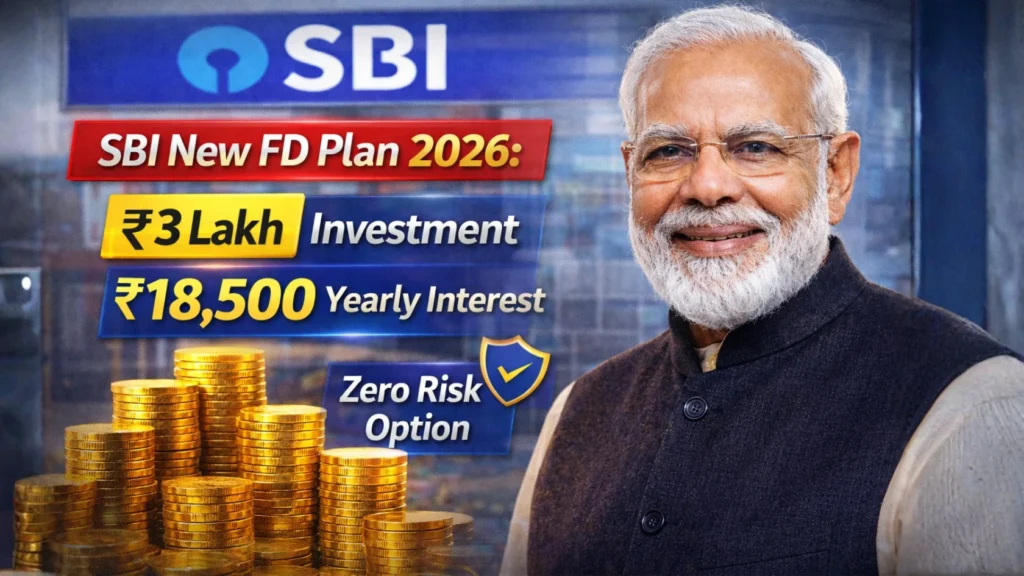
SBI New FD Plan 2026: Fixed deposit investors are now focusing on guaranteed yearly returns, capital safety, and predictable maturity value instead of market-linked risk products, and this calculation example directly targets those priorities. With interest rates stabilising after recent RBI policy cycles, many conservative investors are moving back toward bank FDs. The ₹3 lakh deposit generating around ₹18,500 yearly interest falls in line with current public sector bank FD return range, depending on tenure and category benefits like senior citizen extra interest.
FD Interest Rate Structure Reality
Public sector bank FD interest rates usually stay between 6 percent to 7.25 percent annually for general citizens depending on tenure. Senior citizens often get additional 0.50 percent extra interest benefit. FD interest payout can be monthly, quarterly, or cumulative maturity based on investor choice. Longer tenure FDs usually give slightly higher interest compared to short tenure deposits.
Also Read: EPS Pension Hike 2026: ₹3,000 Minimum Pension Proposal Creates Big Hope for Private Employees
₹3 Lakh FD Interest Calculation Example
If FD interest rate = 6.20 percent yearly
₹3,00,000 × 6.20% = ₹18,600 yearly interest
Monthly equivalent income ≈ ₹1,550 per month (if monthly payout option selected).
If senior citizen rate = 6.70 percent
₹3,00,000 × 6.70% = ₹20,100 yearly interest
Actual payout may vary slightly based on compounding method and tenure selection.
Tenure Options and Return Impact
1 year FD → Usually lower interest band.
2–3 year FD → Mid range interest band.
5 year FD → Often highest interest category.
Longer tenure helps lock interest rate if future rate cuts happen, but reduces liquidity flexibility if money is needed early.
Safety and Risk Factor
Scheduled bank FD is considered one of the safest investment instruments. Bank deposits are insured up to ₹5 lakh per depositor per bank under deposit insurance structure. Capital volatility risk is zero compared to stock market or mutual funds. This makes FD suitable for retirees, emergency fund parking, and conservative investors.
Taxation on FD Interest
FD interest is fully taxable as per income tax slab. TDS usually applies if interest crosses threshold limits in a financial year. Investors can submit Form 15G or 15H if eligible to avoid TDS deduction. Post-tax return should always be calculated for real income planning.
Who Should Consider ₹3 Lakh FD Investment
Low risk investors needing safe yearly return.
Senior citizens needing stable interest income.
Emergency fund parking for capital safety.
Investors balancing risky and safe assets.
2026 Investment Planning Reality
FD works best when combined with other assets like PF, MIS, or debt mutual funds. FD alone may not beat inflation long term, but it provides stability and predictable cash flow. Ladder FD strategy can help manage liquidity and rate fluctuation risk.
Disclaimer: This article is for informational purposes only. FD interest rates, taxation rules, TDS limits, and bank policies may change based on RBI policy and bank notifications. Investors should verify latest FD rates with bank before investing.